
Argentina vs Spain is not Argentina vs England
Updated: Sep 5
Argentina will face Spain in Sunday’s World Cup final, but this is not the England semifinal with different shirts.
There is no Malvinas dispute hanging over the match. No Hand of God waiting for another replay. No Rattín, Beckham or decades of arguments about revenge and redemption.
Argentina vs Spain without England’s historical baggage
Argentina vs Spain carries none of the inherited hostility that shaped Argentina’s rivalry with England.
The two teams have met only once before at a World Cup, a 2–1 Argentine victory during the group stage in 1966. It produced no controversy important enough to be replayed every four years.
Argentina’s quarterfinal against England later in that same tournament was another matter. The confusion surrounding Antonio Rattín’s dismissal took nearly ten minutes to resolve and helped convince English referee Ken Aston that football needed a universal visual language for cautions and expulsions. Inspired by traffic lights, he developed the yellow and red card system introduced at the 1970 World Cup—and still being waved at players today. FIFA

One Argentina match in 1966 was largely forgotten. The other helped change the rules of football.
Argentina and Spain share a much longer and more consequential history, beginning with Spanish colonization. But that history never developed into a modern sporting rivalry. Argentina decisively ended Spanish rule, built its own identity and eventually welcomed millions of Spanish immigrants.
Sunday will still be ferocious. Nobody takes it easy in a World Cup final, especially when several of the players know one another so well. The intensity, however, will come primarily from the game rather than an inherited obligation to settle history.
It is also difficult to argue that the wrong teams reached the final. Spain and Argentina have been the tournament’s two outstanding sides, each following a distinct approach. Spain has conceded only once, controlling matches through structure, possession and remarkable passing accuracy. Argentina has scored more than anyone and repeatedly become most dangerous when a match appears to be escaping.
Spain has expressed its excellence through control and efficiency. Argentina has done it through adaptability, heart and emotion. Twelve of Argentina’s 19 goals have come after the 75th minute, which provides statistical support for what Argentine supporters have already experienced as a month-long cardiac examination. Northeastern University

Against England, history walked onto the pitch with the players. Spain feels more like family meeting there.
Argentina ended Spanish rule—and then looked elsewhere
Spain did not colonize an empty country called Argentina. It conquered and settled territories inhabited by numerous Indigenous peoples that would eventually become part of the Argentine Republic.
Buenos Aires became the capital of the Viceroyalty of the Río de la Plata in 1776. The Spanish Crown imposed its political institutions, religion and economic system, while colonization brought conquest, forced labor, displacement and profound demographic change.
The May Revolution established a government in Buenos Aires in 1810, and independence was formally declared in Tucumán in 1816. The wars were complicated. This was not a neat contest between two already completed nations, and many of the royalist forces were American-born. The result, however, was unambiguous: Spanish rule was over.
What followed was not immediate national unity but decades of conflict over what the new country should become, who should govern it and how much power Buenos Aires should hold. That is another article—and several civil wars.
Unlike the relationship with Britain over the Malvinas, Argentina and Spain have no unresolved territorial dispute. Independence became history rather than a continuing national grievance.
Argentina’s leaders then began looking elsewhere for models of what the new country should become. By the late nineteenth and early twentieth centuries, Argentina had developed into one of the world’s great exporters of grain, wool and meat. Its political and cultural elite wanted Buenos Aires to resemble Paris. French architectural styles reshaped large parts of the capital, while British capital, companies and engineers helped build railways, ports, utilities and the infrastructure connecting agricultural production on the Pampas with overseas markets.
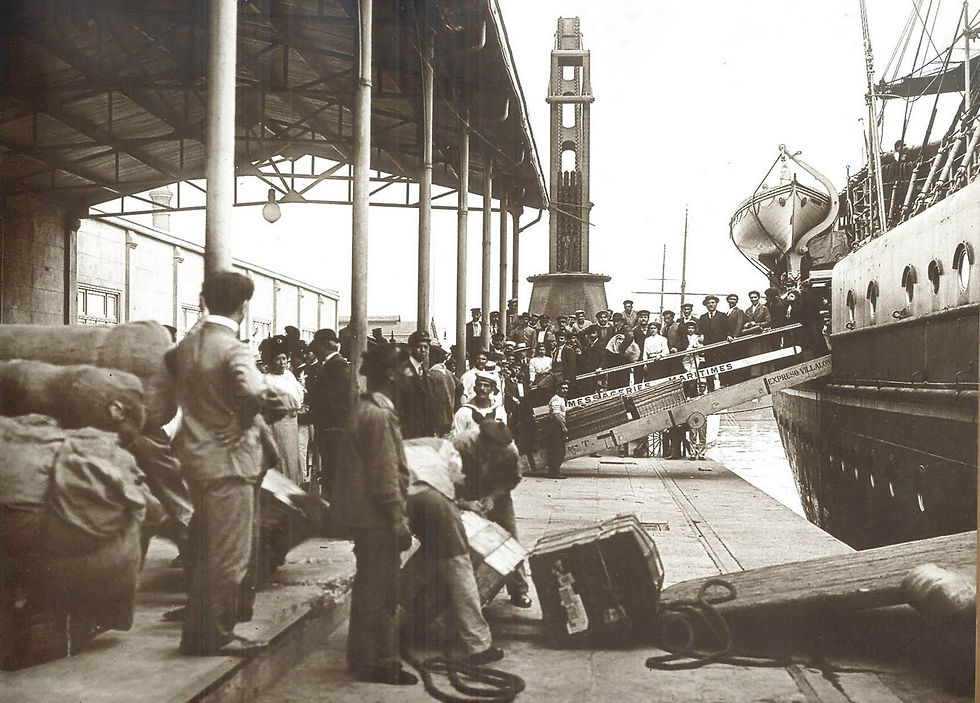
The same period brought enormous immigration from Italy and Spain. Spain was returning to Argentina, no longer as a colonial authority but through millions of individual journeys.
A different racial history is not an innocent one
Any discussion of Argentina’s Spanish inheritance also has to acknowledge the Africans brought to the Río de la Plata through slavery and the Indigenous peoples displaced, exploited and killed during and after colonization.
This matters particularly now because the absence of Black players on Argentina’s national team is being used on social media as supposed evidence that the country deliberately exterminated its Black population.
Argentina participated in the transatlantic slave trade, and Buenos Aires served both as a destination and as a port through which enslaved Africans were transported elsewhere in the Spanish colonies. Enslaved people formed a significant part of the population in colonial Buenos Aires and several interior cities.
The economic system of the Río de la Plata, however, was not organized around enormous sugar, cotton or coffee plantations comparable to those of Brazil, the Caribbean or the American South. Enslaved Africans and their descendants worked primarily in homes, workshops and urban trades, although they also labored in rural production. Buenos Aires maintained a majority free, wage-earning workforce. Cambridge University Press
The process of abolition began in 1813 with libertad de vientres, which declared children subsequently born to enslaved mothers legally free, although many remained under restrictive systems of compulsory service. Article 15 of the 1853 Constitution abolished slavery, and abolition extended to Buenos Aires when it rejoined the national constitutional order. Argentine Constitution
Argentina did not subsequently construct a legal segregation system comparable to Jim Crow. The principal historical studies explain the apparent “disappearance” of Afro-Argentines through a combination of wars, disease, intermarriage, changing racial classifications, the end of forced African arrivals and the enormous scale of European immigration—not through one documented state extermination campaign.

George Reid Andrews’s foundational research challenged the older disappearance narrative, while more recent scholarship has examined how census practices and a national ideal of whiteness made a continuing population appear absent. George Reid Andrews, Cambridge University Press
That does not absolve Argentina of racism. Afro-Argentines were discriminated against, economically marginalized and frequently written out of the national story. They never disappeared, and describing them as an extinct population repeats part of that erasure. But replacing their history with an unsupported story in which Argentina simply massacred its Black population erases them in another way. It obscures the documented history of discrimination, poverty, war, disease, intermarriage, changing racial classifications and a national identity that increasingly presented itself as white and European.
Indigenous Argentines experienced a different and often more openly violent history. Military campaigns seized Indigenous lands, killed and captured people, separated families and forced survivors toward the country’s geographic and economic margins.
It was a familiar pattern across the Americas and other settler societies. Europeans and their descendants declared themselves “civilized,” treated Indigenous peoples as obstacles to progress and used that supposed superiority to justify conquest and dispossession. Argentina was not unique in doing this, but that does not make it less responsible.
I discussed these histories more fully in my previous article about Argentina and England. The important point here is that Argentina’s racial history should be understood on its own terms. Importing the plantation history of the United States or Brazil does not expose Argentina’s actual failures; it makes them harder to understand.
Many of the people spreading these claims have never set foot in Argentina, much less studied its history, but social media has never required familiarity before granting someone absolute certainty.
Argentina’s colonial history becomes a theory that racism was mechanically inherited from Spain, whi A real history of state violence against Indigenous communities is flattened into a claim of total e
One of the major reasons the country’s demographics changed so dramatically was the scale of European immigration. That brings us back to Spain.
Spain returned without the empire
Beginning in the second half of the nineteenth century, Spain and Italy became the two leading sources of European immigration to Argentina. The country’s National Migration Museum preserves the records and stories of people who crossed the Atlantic during this period.
They did not arrive with one uniform Spanish identity. They came from Galicia, the Basque Country, Asturias, Catalonia, Andalusia and other regions with their own languages, foods and traditions. So many came from Galicia that gallego eventually became an Argentine shorthand for practically any Spaniard, regardless of where in Spain the person actually came from.
These immigrants were not representatives of the empire Argentina had fought. Many were working people escaping poverty or looking for opportunities. They established businesses, restaurants, hospitals, clubs and mutual-aid societies. Their children became Argentine without necessarily forgetting where their families had come from.
This distinction matters. Spanish colonization was an exercise of power; Spanish immigration consisted of millions of individual decisions to build new lives in an independent country.
Over time, the movement began flowing in the other direction. Argentine political exiles fled to Spain during periods of dictatorship. Later generations moved there for work or after economic crises, particularly the collapse of 2001. Families, passports and identities continued crossing the Atlantic in both directions.
The modern relationship became less like one between a former empire and colony and more like an extended family—one with disagreements, recurring jokes and two branches capable of horrifying a wine purist in different ways: Coke in Spain, soda water in Argentina.
Spain is hiding all over the Argentine table
Visitors encountering Argentine food usually notice Italy first. Pizza is everywhere, pasta has its own weekly rhythm and gelato shops appear frequently enough to suggest that urban planning regulations require one every few blocks.
Spanish influence is older and less conspicuous because much of it has been absorbed so completely into Argentine cooking.
European cattle were introduced into the Americas by Spanish colonizers. Their descendants spread across the Pampas, where enormous semi-wild herds helped create the rural economy and gaucho culture from which asado emerged. British breeds such as Hereford and Aberdeen Angus transformed Argentina’s commercial herds much later.
The history of Argentine beef therefore includes Iberian cattle, British breeding and generations of local adaptation. Gauchos and rural communities developed the methods and social practices that eventually turned meat cooked over fire into a national ritual.
Empanadas offer an even clearer example of transformation. Filled pastries existed long before modern Spain, and their distant origins are often traced through older Mediterranean and West Asian traditions. But the name and Iberian form crossed the Atlantic through Spanish colonization.
The empanada may be the clearest edible map of Argentina’s regional differences. In Salta, it is generally smaller and particularly juicy, filled with knife-cut beef, green onion and diced potato cooked with beef fat. Tucumán has stricter ideas: the traditional filling centers on finely cut matambre, onion, hard-boiled egg and spices, generally without potato or olives. The province takes the distinction seriously enough to hold the National Empanada Festival in Famaillá.
Mendoza uses as much onion as meat—sometimes considerably more—which gives its empanadas their characteristic richness and moisture. Córdoba moves toward sweet and savory, adding sugar and raisins to the meat, while family recipes continue arguing over olives, potato and carrot.
The form crossed the Atlantic from Spain, but Argentina turned it into a map: each province folded its own ingredients, preferences and rules into the same piece of dough.

Spanish influence also survives in puchero, tortilla, churros and flan. These dishes entered a kitchen already shaped by Indigenous ingredients and were later transformed by African, Italian, Middle Eastern and other immigrant traditions.
Argentina accepted Spanish flan and decided it needed dulce de leche. Churros eventually received the same treatment. Neither modification was strictly necessary, but necessity has never been the only consideration in Argentine desserts.
Even the Spanish stopped sounding entirely Spanish
Spain’s most obvious inheritance is the language, but Argentina transformed that too.
Rioplatense Spanish has its own vocabulary, pronunciation and rhythm. Argentines use vos instead of tú and ustedes instead of vosotros. Italian immigration contributed vocabulary and helped shape the distinctive sound of Buenos Aires speech. Lunfardo gathered words from Italian dialects and numerous other sources before moving from working-class neighborhoods into tango and everyday conversation.
Even vos, perhaps the most recognizable marker of Argentine Spanish, is not an Argentine invention. It developed from older Spanish usage. According to the Real Academia Española, voseo largely disappeared from European Spanish between the seventeenth and early eighteenth centuries but survived across large areas of the Americas.
Argentina kept a form Spain mostly abandoned and made it central to its national voice. Spain gave Argentina Spanish; Argentina gave it back with vos, Italian rhythm and conversations loud enough to include the next table.
Football crossed the Atlantic in both directions
England’s connection to Argentine football began with British immigrants establishing clubs, schools and organized competitions. Spain’s role came later, as one of the main places where Argentine players and coaches built their professional careers.
Alfredo Di Stéfano may be the clearest early example. Born in Buenos Aires, he represented Argentina before later playing for Spain. At Real Madrid he became one of the most important players in European football history, leading the club to five consecutive European Cups and helping establish what Real Madrid would become.

Decades later, Lionel Messi made the same Atlantic crossing under very different circumstances.
Messi left Rosario for Barcelona at 13. The club provided the environment in which his talent could develop, and he eventually became the greatest player in Barcelona’s history. Barcelona formed Messi the professional footballer, but Argentina remained the country he wanted to represent.
His relationship with Spain therefore cannot be reduced to Sunday’s opposition. Barcelona was his club for more than two decades. His children were born there. For a large part of the Spanish football public, especially in Catalonia, Messi is part of their own sporting history. Spain will want to defeat him without needing to pretend he is a stranger.
Argentina’s coach has his own Spanish history. Lionel Scaloni played for Deportivo La Coruña, Racing Santander and Mallorca, built much of his life in Spain and has a Spanish wife. After retiring, he completed his coaching education at the Spanish federation’s academy in Las Rozas.
One of his instructors in 2017 was Luis de la Fuente. Nine years later, Scaloni will coach Argentina against De la Fuente’s Spain in a World Cup final. Reuters describes their mutual respect and the Spanish experiences that helped shape Scaloni’s coaching career.
Barcelona’s present meets Barcelona’s greatest player
Eight members of Spain’s World Cup squad currently play for Barcelona: Lamine Yamal, Pedri, Dani Olmo, Pau Cubarsí, Ferran Torres, Gavi, Eric García and Joan García.
Only Pedri was Messi’s senior first-team teammate at the club. The others arrived later or were still developing when Messi left, but they inherited a Barcelona whose modern history remains inseparable from him.
Pedri has called Messi the greatest footballer in history and described himself as fortunate to have played alongside him. Lamine now occupies Messi’s former position on the right and wears Barcelona’s number 10. He has spent much of his young career being compared with a player he openly admires.
Messi has returned that respect, identifying Lamine as the outstanding player of the new generation.
Their connection began long before Lamine could remember it. In 2007, the Barcelona Foundation and the newspaper Sport produced a charity calendar supporting UNICEF projects. Families entered a draw to have their children photographed with Barcelona players, and one of the selected babies was a five-month-old Lamine Yamal.
The resulting photograph shows a 20-year-old Messi bathing Lamine in a small plastic tub. A rubber duck helped the shy young footballer and the baby relax for the camera.
Almost nineteen years later, they will meet as two of the central figures in a World Cup final. And Lamine is only the most extraordinary example. A montage circulating before the final shows Messi beside a succession of babies, children and teenagers who grew into players sharing the pitch with him on Sunday—some wearing Argentina’s shirt and others Spain’s.
None of this means Spain’s Barcelona players will hesitate. They are trying to win a World Cup for their country, and doing so requires defeating the man who helped define their club. Admiration and competition are not opposites. Knowing exactly who stands across from them may make the challenge more meaningful.
Speed completely misunderstands the rivalry
IShowSpeed is not covering this World Cup so much as using it as a travelling provocation show. He has spent the tournament supporting whichever team happens to be playing Argentina, changing shirts, performing supposed curses and antagonizing Argentine supporters because their anger gives him content.
During Argentina’s match against Cabo Verde, a supporter directed racist abuse at him while he was livestreaming. The remark was indefensible, and nothing Speed had done could excuse it. The person who said it is responsible for saying it. FIFA subsequently investigated the incident.
But Speed’s format depends on entering crowds, provoking confrontations and keeping the camera trained on whichever reaction produces the most attention. That should not be confused with a neutral portrait of Argentine supporters. There is no evidence that he deliberately sought a racist response, but there is abundant evidence that he seeks conflict because conflict is valuable content. That is his brand.
With Portugal eliminated, Speed has now asked Lamine Yamal to “save” Ronaldo fans by defeating Messi.
Consider how ridiculous that request is. Lamine currently wears Barcelona’s number 10—the shirt Messi made famous. Messi is the greatest player in Barcelona’s history. Cristiano Ronaldo spent his defining years in Spain playing for Real Madrid, Barcelona’s archrival, and repeatedly faced Messi from the opposite side of El Clásico.
Speed is therefore asking the heir to Messi’s Barcelona shirt to protect the legacy of a Real Madrid legend by defeating the greatest Barcelona player who ever lived.
That only makes sense if your entire understanding of football begins and ends with an internet argument between two famous names. Speed knows that Messi and Ronaldo are rivals. Everything beyond that—the clubs, countries, history and loyalties involved—appears to have escaped him.
Speed has been praised as a football “phenomenon” after two weeks of training. The man sharing the pitch with him here is Paul Pogba, an actual World Cup winner. The footage allows readers to judge the comparison for themselves.
Lamine is not playing to rescue Ronaldo’s reputation or preserve talking points for his fans. He is playing to win the World Cup for Spain. The Barcelona players will try to defeat Messi because that is what the match requires, despite their admiration for him—not because supporters of Real Madrid’s most famous modern player need saving.
Family does not mean friendly
Argentina and Spain do not need historical hostility to produce a fierce final.
The players know one another’s games. Many have been teammates or regular opponents in European club football. The coaches share a professional history. Spain knows what Messi means to Barcelona, while Messi knows the footballing culture that produced much of the team standing between Argentina and another World Cup.
There will be hard tackles, arguments, tactical fouls and several attempts to influence the referee using vocabulary both countries understand perfectly. There is no need to manufacture hatred around any of it.
Argentina became independent by ending Spanish rule. It then spent two centuries transforming its Spanish inheritance alongside Indigenous, African, Italian, British and many other influences. Spain remained present in Argentina’s language, families and food, while generations of Argentines crossed back to Spain and became part of its football.
England arrived at the semifinal carrying political disputes and famous football wounds into the stadium. Spain arrives carrying a shared history, former teammates, Scaloni’s former instructor, eight Barcelona players and a photograph of Messi bathing the baby who may now stand between him and another World Cup.
When the whistle blows, none of that will make either team gentler. This time, history explains why they recognize one another—not why they hate one another.


meydaelinaa