
Old Poison, New Fires: Antisemitism in Argentina Has Deep Roots
Someone sent me a reel. An Argentine historian, published, credentialed, calm, making the case that Argentina's reputation as a Nazi haven is overblown — more Cold War myth than documented fact. It sounded reasonable. I shared it with a group of friends. One of them wrote back and asked if I was sure about what the guy was saying.
I wasn't. And I was a little embarrassed — I'm not even a reporter.
So I started checking. What I found wasn't just that the historian was wrong in important places. The question he was answering — did Perón really facilitate Nazi immigration? — turned out to be the easy part. The harder part was what I found underneath it: a documented thread of institutional antisemitism in Argentina — intertwined with conspiracy narratives and political myths that are still circulating today — that didn't start with the Nazis, didn't end with Perón, survived a military dictatorship that used it as a torture instrument, and is still running right now — in reels being shared on Instagram and WhatsApp across Argentina and the world.
I will get to Duzdevich's argument — and where it falls short — but before I do, let me show you what I found underneath it. Because the Nazi immigration question, it turns out, is almost the least interesting part of the story.
I have lived in Buenos Aires since 1999. I have been hearing the Patagonia-Jewish conspiracy story, in one form or another, for most of that time. But I had never followed it all the way back to its roots before.
The Grenade That Wasn't Israeli
In January 2026, wildfires tore through the Patagonia region of Chubut province. Thousands of hectares burned. Families were evacuated. It was a genuine disaster.
What happened next was a different kind of disaster.
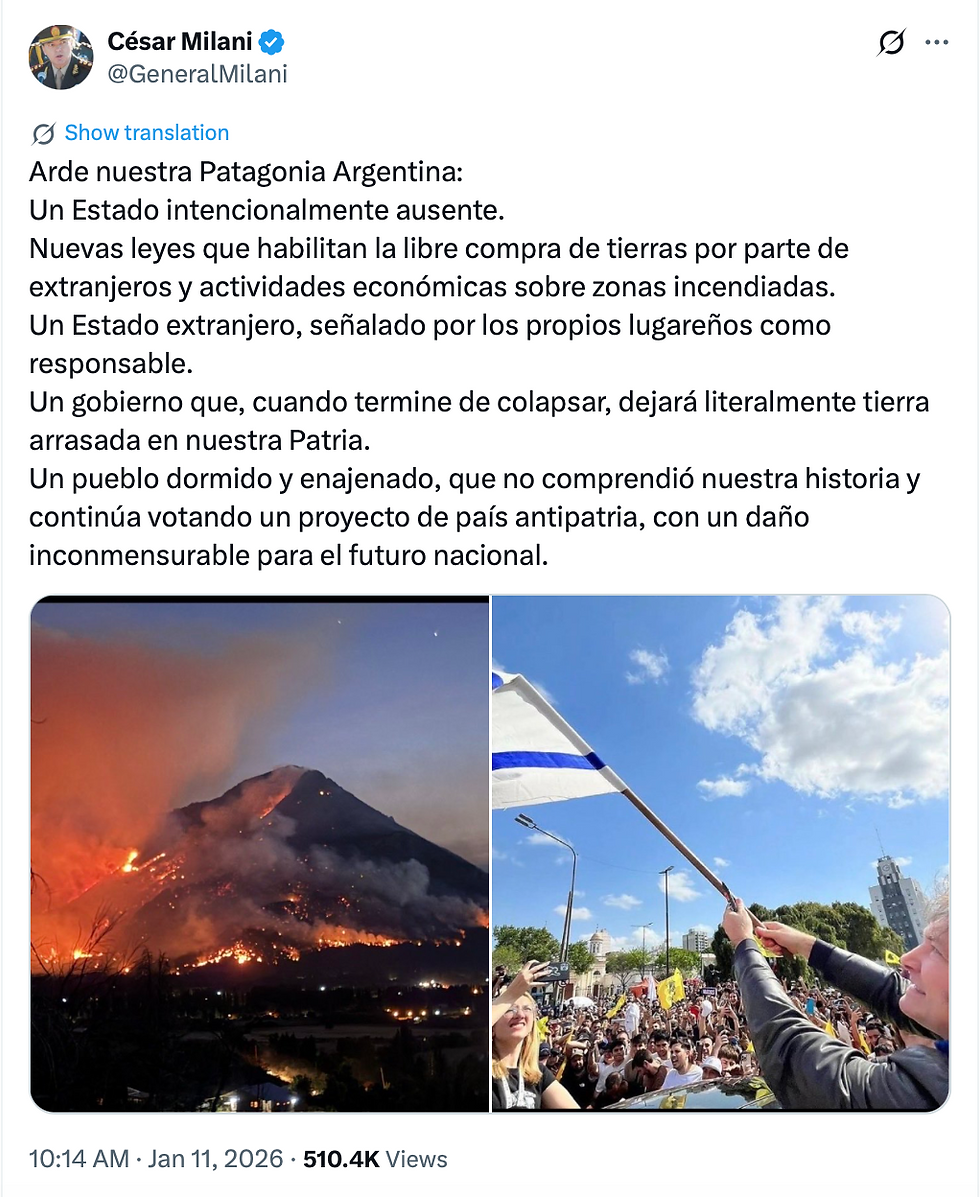
César Milani, a retired Argentine Army general and former deputy chief of the armed forces, posted on Twitter that "a foreign state, pointed out by the locals themselves as responsible," had caused the fires. He did not name Israel directly, but he paired the post with a photo of President Milei waving an Israeli flag. The implication was not subtle.
Marcela Feudale, host of Feudalísima on Radio 10 — one of Argentina's major national stations — went further on air, claiming to have learned from "good sources" that two Israelis had used an IDF grenade to start the fires. An Israeli military grenade. In Patagonia. The claim went viral.
The grenade part deserves its own paragraph, because the full story is more interesting than either side of the argument.
In late November 2025 — weeks before the fires — a recreational diver was swimming in Lago Epuyén when he found a grenade on the bottom of the lake. He left a floating marker, got out of the water, and called the police. Over the following weeks, underwater sweeps turned up six grenades in total. The Chubut police explosives unit confirmed they were Argentine-made FMK model devices, estimated to be from the late 1970s, in varying states of rust and deterioration. Chubut Police Chief Commissioner Andrés García confirmed publicly that the grenades were deactivated, posed no danger, and were consistent with old obsolete military material — occasional discoveries of old military ordnance have been reported in Argentina, typically isolated incidents with varied and sometimes unclear origins.

Then the fires started in January. By the time the grenade story reached social media, the lake-bottom hardware from the 1970s had been rebranded as a freshly planted Israeli IDF weapon. Governor Ignacio Torres confirmed to Infobae that the grenades were Argentine FMK2, manufactured by Fabricaciones Militares, used exclusively by the Argentine Armed Forces. Argentina's leading fact-checking outlet, Chequeado, independently confirmed the same, noting that a visual comparison between the grenade found and an Israeli M26 showed they were not the same device.

Feudale apologized on air, breaking down as she read her statement. "I made a mistake and I apologize. I recognize that my comment contributes to the spread of hate speech." She was also a professor of journalism. She knew what she had done.
Milani never apologized.
The Plan That Refuses to Die
I have been hearing a version of this story since I moved here in 1999. Over those 25 years I have watched it morph — the specific allegations change, the vehicle changes, but the architecture stays the same. What I did not know until I started digging was that the conspiracy has a formal name, a documented origin, and roots that go back not to the internet, not to social media, but to a military barracks in 1971.
But first, the kernel of truth the conspiracy feeds on — because every durable conspiracy theory needs one.

In the 1890s, Theodor Herzl, the founder of modern Zionism, genuinely debated "Palestine or the Argentine" as the location for a Jewish homeland. Argentina's vast, fertile, underpopulated land made it a real candidate in those early discussions. Around the same time, philanthropist Baron Maurice de Hirsch acted on that potential — not by plotting a state, but by funding agricultural cooperatives in Argentina for Jewish refugees fleeing pogroms in Tsarist Russia. The Jewish Colonization Association established settlements across the Pampas and in the northeast, among them Moisés Ville in Santa Fe, which still exists today. These were transparent humanitarian initiatives, documented openly, built on land purchased legally in a country that was actively recruiting European immigrants of all backgrounds.
By 1948, when the State of Israel was founded in Palestine, any discussion of Argentina as an alternative was long settled history. The Zionist movement had made its choice. No Israeli government has ever proposed a territorial claim in South America.
The conspiracy took that benign 19th-century history — real proposals, real settlements, real people — and reframed it as the first phase of a secret ongoing plan. In 1971, the Plan Andinia appeared as a leaflet circulated among Argentine Army officers, claiming that international Jewry was planning to take over southern Argentina and establish a second Jewish state. In the 1970s it was formalized and published by Argentine neo-Nazi writer Walter Beveraggi Allende. During the 1976–1983 military dictatorship, it moved from fringe pamphlet to state instrument — journalist Jacobo Timerman, detained and tortured by the junta, recounted in his memoir Prisoner Without a Name, Cell Without a Number that his interrogators pressed him for information about Israeli military preparations for an invasion of Patagonia. The generals treated it as operational intelligence.
No evidence of any such plan has ever been found. The ADL, Argentine historians, the Zionist Organization of Argentina, and the Argentine state itself have all formally debunked it. The Zionist Organization of Argentina stated in January 2026: "There neither is nor ever has been a plan by the State of Israel or Zionism to occupy Argentine territory. Its invocation in the 21st century reveals only ignorance, bad faith, and a clear discriminatory intent."
And yet here we are. The story finds a new vehicle every few years. In 2001–2002, as Argentina's economy collapsed, a version circulated that the government would sell Patagonia to pay its foreign debt. In 2012, an Israeli tourist named Rotem Singer accidentally started a fire in Torres del Paine National Park in Chile by not properly extinguishing toilet paper he had been burning. He acknowledged negligence, entered a plea deal, paid a $10,000 fine, and left the country. Within days, Chilean politicians were asking whether he had been "sent by Israel after killing Palestinian children." In January 2026, a separate Israeli tourist was caught smoking on a trail in Torres del Paine — fined, banned from Chile for three years, sent home. By the time that story reached the reels circulating in my WhatsApp groups, it had become evidence of a military reconnaissance operation.
A reasonable person might ask why Israeli tourists keep showing up in these incidents at all. The answer is demographic. After completing mandatory military service, large numbers of young Israelis take extended trips to South America as a decompression gap year — and Patagonia is one of their primary destinations. The concentration is high enough that Bariloche has acquired the informal nickname "Israeloche." Torres del Paine and the surrounding wilderness see so many Israeli backpackers that some hostels carry Hebrew menus. When a large population of young campers converges on one of the most fire-prone environments on earth — dry conditions, dense native forest, winds that can turn a spark into a disaster in minutes — accidents happen. The CONAF director in Chile noted in 2017 that Israeli tourists accounted for a disproportionate share of park expulsions, and attributed it to a tendency to ignore posted rules — not to any coordinated plan. The conspiracy version takes that demographic reality, removes the obvious explanation, and substitutes coordinated malice. That substitution is the entire mechanism. I was in Torres del Paine the year after the 2011 fire. On a boat crossing the lake, a Chilean tour guide was making sweeping comments about Israelis — the kind of generalizations that assume an entire nationality behaves as one. I recognized it immediately. I grew up in the United States, where that kind of logic gets applied to Latinos, to Black people, to anyone who can be reduced to a category when something goes wrong. I have been a victim to this type of thing first-hand. I told him so, directly, in front of the whole group — that where I came from, someone would use the same logic to call him a spic and lump every Spanish speaker into one story. The boat got quiet. The point, I think, landed. Generalization is generalization. The mechanism does not change based on who is doing it or who it is aimed at.
The facts at the bottom of that ladder are real. A negligence case in 2011. A smoking violation in 2026. Grenades from the 1970s on a lake bed. A genuine wildfire in Chubut. Each one is real. The conclusion drawn from all of them is fabricated. The mechanism has been running in this country for nearly a century, and I have been watching a piece of it firsthand since I arrived.
The Land Question Nobody Is Actually Asking
Here is the part that makes the conspiracy particularly effective in 2026: there is a real land story in Patagonia. It just has nothing to do with Israel.
Argentina's land law currently caps foreign rural ownership at 15% of national, provincial, and municipal territory. According to a study by the Observatorio de Tierras — researchers from CONICET and the University of Buenos Aires — 13 million hectares of Argentine land are already in foreign hands, roughly five percent of national territory. In 36 districts, foreign ownership already exceeds the permitted 15% cap. In San Martín de los Andes, 54% of land is no longer Argentine-owned.
The largest foreign holders of Argentine land are not Israelis. According to data from The Latin Investor, USAmericans own over 2.7 million hectares — the single largest bloc of foreign-held land in the country. Italians hold approximately 2 million hectares. Qatari investors, admitted under Mauricio Macri, have already acquired 110,000 hectares along Route 40, between Bariloche and El Bolsón. The Benetton Group — the Italian clothing company — holds close to a million hectares in Patagonia, the largest private landholding in Argentina.
In March 2026, the Milei government sent a bill to Congress proposing to relax those foreign ownership restrictions, effectively allowing private foreign individuals to buy rural land under the same rules as Argentine nationals. The same legislative package proposed modifying the Fire Management Law — which since 2020 has prohibited real estate development, subdivision, or changes in land use on burned territory for between 30 and 60 years. In early 2026, Congress also approved modifications to the glacier protection law, giving provinces the power to allow mining in periglacial areas near the Andes. Environmentalists warned the reform "endangers the water of millions of people" and announced legal action.
The Buenos Aires Times reported that the chief prosecutor of Lago Puelo, Carlos Díaz Mayer, said the various conspiracy theories were "an invention," and that the main investigative hypothesis was that the fires were deliberately started in the context of a local land dispute — not a foreign military operation.
The Llamamiento Judío Argentino — the Argentine Jewish Appeal — put it with precision in a statement released during the January fires. While condemning the antisemitic conspiracy theories, they pointed directly at what was being obscured: "local propagandists import conflicts alien to our social history in order to divert attention from the true political and economic culprits of this scourge, among whom undoubtedly are Qatari investors, originally admitted under Mauricio Macri, who have already acquired 110,000 hectares along Route 40, between Bariloche and El Bolsón."
Concern about Patagonian land is legitimate. The data supports it. The conspiracy pointed at the wrong people and let the actual story walk out the door.
But to understand how that misdirection works so reliably, and has worked for so long, you have to go back further than 2026. Much further.
A History of Antisemitism in Argentina: Buenos Aires, 1938
Before I get to Perón and the ratlines, I want to stop at a photograph.
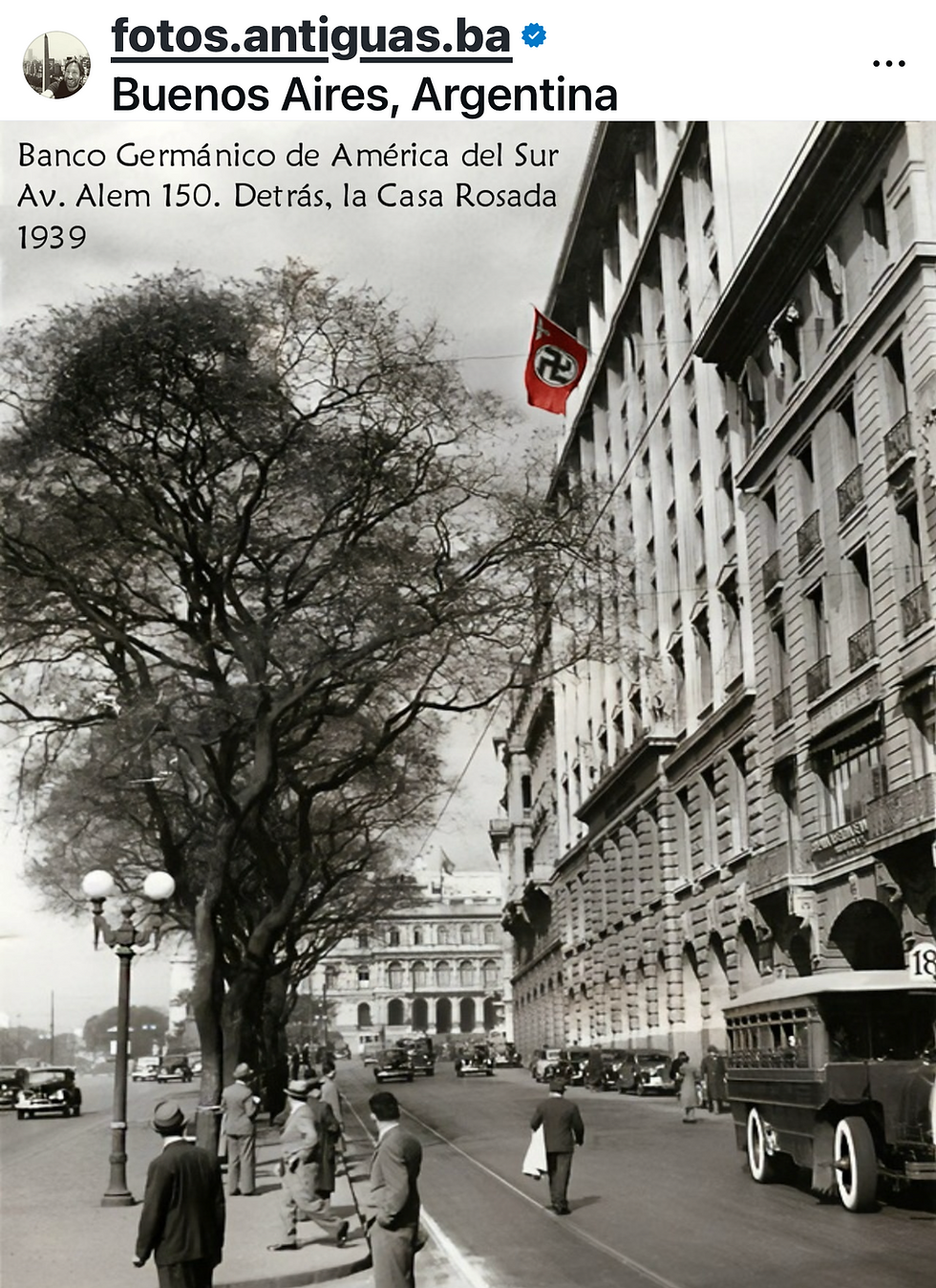
There is a photographer on Instagram — @fotos.antiguas.ba, run by José Díaz Diez — who has been sharing archival images of Buenos Aires from the 1930s and 1940s. I have been following his account for some time and I love these pictures. His archival work has been declared of Cultural Interest by the Buenos Aires Legislature, and he has published two books — Buenos Aires en el tiempo 1: el centro de la ciudad and Buenos Aires en el tiempo 2: recorriendo los barrios — available at Tónico Café, Riobamba 1173, Recoleta, or by writing to fotos.antiguas.ba@gmail.com.
José has generously given permission to use his images here, and I want to acknowledge that. The caption on one of them reads: "Parece alguna imagen de Berlín, pero no, es Reconquista y Mitre, CABA." It looks like an image from Berlin, but it's Reconquista and Mitre, Buenos Aires. Swastika flags hang from the facade of a building in what is today the financial district. Ordinary buses, ordinary pedestrians, ordinary city life in the frame below them.

Another image shows the interior of the Club Alemán, Córdoba y Maipú, in 1939. Two men at the reception desk conducting routine club business. On the wall behind them: a portrait of Adolf Hitler.

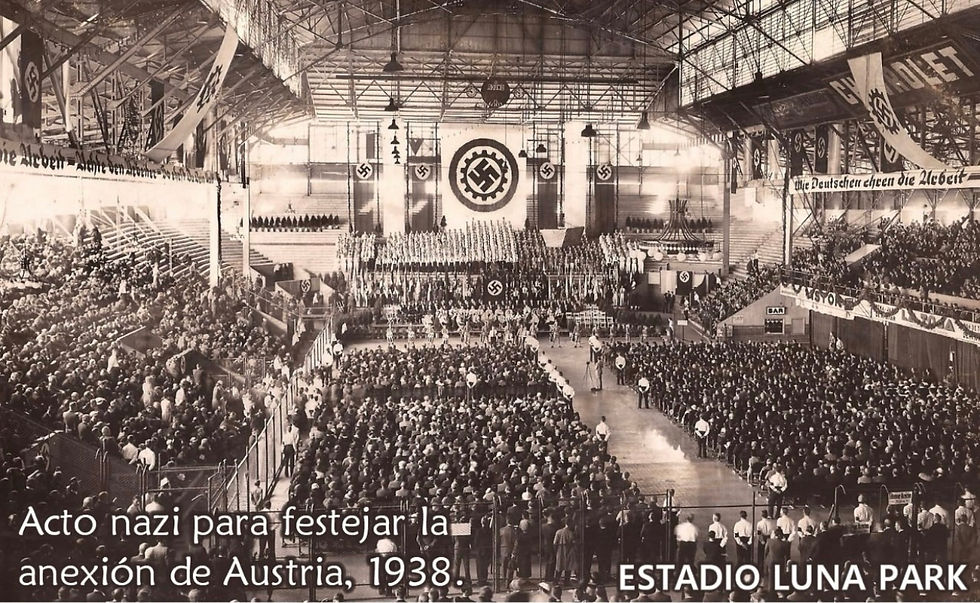
A third shows the Luna Park stadium in 1938, filled to capacity for a rally celebrating the annexation of Austria. Captioned: "Acto nazi para festejar la anexión de Austria, 1938. Estadio Luna Park." According to the German History in Documents and Images archive, around 20,000 people attended. Argentine fascist youth were there alongside Hitler Youth and German Workers Front representatives. It was one of the largest pro-Nazi rallies held outside of Germany. The Argentine Foreign Ministry's response to the violence that broke out in the streets outside was to apologize — to the German chargé d'affaires.

A comparable rally was held at Madison Square Garden in New York in February 1939 — 20,000 USAmericans saluting under a 30-foot portrait of George Washington flanked by swastika banners. The point is not which country had the bigger rally. The point is that this one was in Buenos Aires. I am dwelling on these images because they answer a question that the revisionist argument never quite addresses: where did the receptive environment come from?
By 1938, long before Perón, long before any Nazi boarded a postwar ratline ship, Buenos Aires police had banned Yiddish at public meetings. Bombs had been placed outside synagogues. During the presidency of Roberto Ortiz — described at the time as more sympathetic to Jews than his predecessors — Jewish teachers and physicians were dismissed from public institutions and Jewish patients excluded from hospitals. Argentina's antisemitism in the postwar years grew in soil that Argentine institutions had been cultivating for decades. The Nazis who came after the war arrived to find it already well-tended.
What Perón Actually Did
The historian whose reel started all of this — Aldo Duzdevich, a published author, former Montonero dissident, and one-time Kirchner-era government appointee — argues that Argentina's Nazi reputation is largely political myth, inflated by a 1946 U.S. State Department campaign against Perón. He cites a 1994 Argentine foreign ministry commission whose conclusions included that there were "no signs that Argentine authorities massively encouraged Nazi or fascist criminals," and points to a forest planted in Jerusalem in Perón's honor in 1955 as evidence that Israel itself did not view Argentina as a Nazi state.
These are not fabrications. The commission existed. The forest exists. The U.S. did run a disinformation campaign against Perón through the so-called Blue Book of 1946 — 130 pages written at the direction of Ambassador Spruille Braden, published days before the 1946 election with the explicit goal of torpedoing Perón's chances. Braden was the U.S. Ambassador to Argentina in 1945, a man so openly hostile to Perón that his name became a campaign slogan. It backfired: Argentines saw it as foreign interference, and Perón turned it into a rallying cry — Braden o Perón. Tel Aviv University historian Raanan Rein, a serious academic, has argued that more Nazis by raw numbers entered the U.S. and USSR than Argentina, and that the "Nazi paradise" narrative was partly politically constructed. There is also this: Perón was the first president in the region to recognize the State of Israel in 1948, established an Argentine embassy there, and appointed the president of the Argentine Jewish community as ambassador, reportedly over his own cabinet's objections. Those points belong in any honest account.
But here is what the argument leaves out.
Perón appointed Santiago Peralta, a man with a documented record of antisemitism, as his immigration commissioner. He appointed Rodolfo Freude, son of a Nazi-linked German-Argentine millionaire, as head of Argentina's first intelligence bureau. Both men used their positions to streamline pathways to citizenship for war criminals. Journalist and historian Uki Goñi, drawing on Swiss, Argentine, and European archives, documents transfers totaling over one million Swiss francs — equivalent to more than $21 million today, which he identifies as funding for ratline operations through Scandinavia and Switzerland.
And then there are the tapes. These are Perón's own words, recorded in 1974, months before he died: in those recordings, he framed his actions as protecting German officials from what he called the "outrage" of the Nuremberg Trials.
Duzdevich's argument disputes the scale of what happened. What the tape does not leave room to dispute is the intent.
It is also worth noting that Perón was not unique in wanting German industrial expertise and corporate capital. Operation Paperclip was the U.S. version of the same calculation, over 1,600 scientists and engineers from the Third Reich imported to work for the U.S. government. Among them was Wernher von Braun, who had built V-2 rockets using concentration camp slave labor, with more than 20,000 workers dying in the process. He became director of NASA's Marshall Space Flight Center. A crater on the moon is named after him. The U.S. recruited Nazi-affiliated personnel extensively, gave them prestigious positions, and never called itself a haven. Argentina was labeled a Nazi paradise while the U.S. quietly ran its own parallel program and faced a fraction of the international scrutiny. Whether that asymmetry was deliberate distraction or simply Cold War opportunism, historians continue to debate. What is not debated is that the criticism directed at Argentina was selectively applied.
The difference with Argentina was not the recruitment of German industry. It was what else came with it, and how actively the Argentine state built infrastructure to ensure that war criminals arrived safely, with new identities, funded by state money, processed by antisemites placed in positions of authority specifically for that purpose.
This is the part where Perón becomes genuinely difficult to argue about, and where the difficulty is itself the point. He was not an ideologue in the way Hitler or Mussolini were ideologues. He was a tactician, and his tactic was to be useful to as many people as possible while remaining accountable to none of them. He recognized Israel and appointed a Jewish community leader as ambassador. He also appointed an avowed antisemite to run immigration. He championed the descamisados and jailed journalists. He promoted beef consumption as a symbol of workers' dignity, the idea that a laboring man deserved a steak was central to his political brand, and then instituted mandatory meatless days, restricting beef twice a week to preserve export earnings. The public outrage was immediate and entirely predictable. He armed the left and then turned on it. He invited Nazi war criminals and cultivated relationships with revolutionary Marxists.This is why, decades after his death, the left and right wings of his own movement were killing each other in the streets — they had both been told what they wanted to hear. The historian Tulio Halperín Donghi called him "the fact that cannot be integrated" in Argentine political life. And it explains why both sides of the argument about Perón and the Nazis can find something real to point to. The question is not whether Perón had Jewish friends or recognized Israel. The question is what his government built, who it served, and who walked through the door it left open.
From the Ratlines to the Torture Room
The men who came through those ratlines did not live in hiding. Jorge Antonio, a close Perón collaborator, later told historians: "Everybody knew perfectly well it was Adolf Eichmann, and he was listed at Mercedes-Benz as Eichmann from 1950 until they arrested him in 1960. Nobody cared, nobody paid attention to him." Whether that awareness was as broad as Antonio claimed is debated, but Eichmann did live in a Buenos Aires suburb for a decade before Israeli agents tracked him down in 1960.
That ideology took root in Argentine institutions, nowhere more catastrophically than in the military. During the 1976–1983 dictatorship, Jewish prisoners were subjected to specifically antisemitic torture, with interrogators pressing them about the Andinia Plan as though it were established fact. Some generals treated it as operational intelligence. Jewish victims were disproportionately targeted and subjected to treatment harsher than that given to non-Jewish prisoners.
The thread from the 1938 Luna Park rally to the 1976 torture rooms runs through documented institutions, named individuals, and a political culture that absorbed rather than expelled the ideology it had hosted.
The AMIA Bombing and the Long Tail
On July 18, 1994, a bomb destroyed the AMIA Jewish community center in Buenos Aires. Eighty-five people were killed. It remains the deadliest antisemitic attack in the Western Hemisphere since the Holocaust.
Iranian state sponsorship has been established by Argentine and international investigators. Several Iranian officials were indicted. For years afterward, the case was effectively buried by successive Argentine governments.
One of the figures accused of serving as intermediary between Iran and the Argentine officials who granted impunity to the Iranian suspects is Luis D'Elía — the same opposition politician who posted in January 2026 that "the Israelis are burning Patagonia."
These are not the same actors as the 1930s nationalists or the Perón-era ratline operators. But they are echoes of the same political culture — one in which antisemitism has served as a usable instrument across generations and across ideological lines.
Two Conspiracies, One Function
Something else circulated in those same WhatsApp groups alongside the Israeli grenade story: the claim that the Mapuche — specifically the radical faction known as the RAM, Resistencia Ancestral Mapuche — were responsible for the fires.
The RAM has a documented history. Their leader, Facundo Jones Huala, served nine years in Chile for arson and has publicly stated his support for "incendiary attacks against the infrastructure of the capitalist system." The Milei government declared RAM a terrorist organization in February 2025. The arson history is real.
But most Mapuche communities do not support RAM's methods. The Cushamen community itself described RAM's actions as terrorism and demanded security force intervention. "The Mapuche are burning Patagonia" and "the RAM has carried out arson attacks" are different statements, and collapsing them is exactly the kind of categorical scapegoating the Israeli narrative relies on as well.
Two conspiracies circulating simultaneously about the same fires. One targets Jews. One targets indigenous people. Both collapse a complicated question — who owns Patagonian land, under what conditions, and how did those conditions come about — into a convenient minority scapegoat. Both redirect anger away from the harder question and toward a group that can carry it.
That is a pattern. And it has a 90-year documented history in this country.
What Happened When I Checked
I live in Buenos Aires. I love this city and I would not trade it for anywhere else. I run food tours through neighborhoods whose every block contains a story about immigration, labor, politics, and culture. The complexity is part of what makes it extraordinary.
But this piece is not about Argentina as exceptional. Every country has this history somewhere in its bones. The U.S. recruited over 1,600 Nazi scientists through Operation Paperclip. Australia, Canada, and Britain absorbed individuals with Nazi pasts. The criticism directed at Argentina was selectively applied by governments running their own parallel programs. That is documented and worth saying.
What is equally documented, and equally worth saying, is that Argentina's relationship with institutional and political antisemitism is not a myth invented by Cold War propagandists. It is a long historical arc: a street corner that looks like Berlin, a stadium rally of 20,000, state-facilitated networks that brought war criminals to Buenos Aires, torture rooms where generals interrogated prisoners about a fictional Jewish invasion, the deadliest antisemitic bombing in the Western Hemisphere, and a retired general who as of this writing has still not apologized for a post he made in January 2026.
One more thing, because someone will definitely get the wrong idea. I am not a fan of Benjamin Netanyahu. Not even a little. He came onto my radar when he started butting heads with Obama and I have not liked anything he has stood for since. He is someone who, like a few others I could name, seems to have figured out how to stay just out of reach of the law. That is a separate conversation. What I am defending here is not Israeli government policy. What I cannot stand is misinformation. A fabricated grenade story, a 50-year-old conspiracy theory recycled for WhatsApp, a retired general who never apologized — that is what this piece is about. We are all swimming in misinformation right now and most of us, myself included until a friend asked me one question, are not checking what we share.
While the conspiracy blamed Israelis for burning Patagonia to buy it cheap, USAmericans were already sitting on 2.7 million hectares of it. That detail did not trend on Twitter. It did not generate reels. Nobody broke down crying on the radio about it.
As of April 2026, the same fabrications have been translated into Turkish and are circulating with hashtags like #IsraelisAParasite — the invented 100,000-hectare allocation, the "Zionists setting fires" claim, all presented as fact to an entirely new audience with no context for any of it. The story keeps finding new languages.

Someone sent me a reel, and a friend asked if I was sure. I am glad she did.
Curious about the layered history of Buenos Aires beyond the headlines? That history is exactly what we explore on our tours — immigration stories, neighborhood transformations, the culture behind the food. You can find out more at AsadoAdventure or take a look at our food and cultural tours.
Editor's note, May 29, 2026: An earlier version of this article stated that more Nazis by raw numbers entered the U.S. and USSR than Argentina. That comparison is not supported by the available evidence and has been removed. The documented figure for Argentina is approximately 5,000 Nazi war criminals. Operation Paperclip brought approximately 1,600 German scientists and engineers to the United States. The qualitative argument — that the U.S. recruited Nazi-affiliated personnel extensively while facing far less international scrutiny than Argentina — remains accurate and is reflected in the revised paragraph.
For further reading: Uki Goñi's The Real Odessa (Granta Books, 2002, updated 2022) is the primary archival source on the ratlines. Jacobo Timerman's Prisoner Without a Name, Cell Without a Number covers the dictatorship period firsthand. The Wiener Holocaust Library has published extensively on pre-Perón antisemitism in Argentina. Argentina's own declassified intelligence files, released by the Milei government in 2025, are publicly available through the Argentine judiciary.


Excellent research Frank. I would note, as someone here who's Jewish, that in the 21 years I've been here, I've never experienced any antisemitism, nor have, as best I know, any of my Jewish friends. I'm far more comfortable being "openly" Jewish here than anywhere else I've ever lived. That includes New York City, where I lived for 23 years. I think there's a big difference between the antisemitism of many of the country's past leaders, and a few vocal right wing pundits, and the average Argentine in the street.