
Argentine Wine Tasting in Buenos Aires: Four Bottles, Four Regions, One Table in Palermo
Updated: May 8

Most people who visit Buenos Aires try one Argentine wine region. They sit down at a parrilla, they order a Malbec from Mendoza — probably a Catena, probably a Zuccardi — and they go home convinced they understood the country. The wine was probably excellent, but Argentina has 24 provinces and at least 17 of them produce wine, from Jujuy in the far north down to Chubut in Patagonia. Most of that never leaves the country.
I've been thinking about this gap for a while. And it's part of why, when I launched the Wine Discovery page on the AsadoAdventure site, I reached out to Bertie and Aby to actually experience what they do before putting my name behind it.
They invited me to a wine tasting on a Saturday afternoon in early May. I walked over to Soler 5650 in Palermo Hollywood, pressed 801, and went upstairs to find out what Argentine wine looks like when someone who really knows it gets to do the curating.

Who Are Bertie and Aby?
Bertie is an English sommelier with a WSET Level 3 certification who moved to Buenos Aires and fell deep into the country's wine culture. Aby is a Buenos Aires native and a chef who grew up making traditional Argentine food at large family gatherings. They started Wine Discovery in 2016 — the same year AsadoAdventure was born, as it happens. We are both veterans of the Buenos Aires food and wine experience circuit, which means I knew immediately that these were my people.
The format is simple and very good: Bertie introduces each wine, talks about the producer, the region, the story behind the bottle. Then Aby appears from the kitchen with a regional food pairing made from scratch. Four wines. Four pairings. One long table. Wine rack lining the wall. Plants on the terrace catching the afternoon light. The Argentina Wine Map laid out flat on the table between the glasses so you can follow along geographically.
Some of the bottles on that table don't make it onto export lists. Some barely leave the province.

It has the relaxed rhythm of eating at a friend's place — if your friend happened to know Argentine wine the way some people know football statistics.
I also met Bonnie, their dog, who was lounging on the couch with the kind of composure that suggested she had seen many bottles opened and found all of it beneath her dignity.
The Tasting: Four Wines, Four Corners of the Country
The Opener: Mevi Cabernet Rosé 2024, Mendoza
Before the formal tasting began, Bertie poured a glass of Mevi Cabernet Rosé from Mendoza. Pale salmon color, very dry, clean finish. A wine designed to ease you in and get you talking before the serious geography lesson begins. It worked.

Mevi is a family winery founded in 1991 by Oscar Vignart and Rolando Meninato, with a vineyard at the foot of the Andes in Maipú, Mendoza. They were named Argentina's Winery of the Year at the 2024 New York International Wine Competition — not a bad credential for the welcome glass.

Wine 1: Altupalka Torrontés 2025, Salta
The tasting proper opened with the Torrontés, and if you haven't encountered this grape before, it's one of those wines that makes your palate argue with your brain. The nose is floral and perfumed, almost sweet — jasmine, white peach, citrus blossom. Then you take a sip and it's completely dry. Bone dry. Fresh. Alive.

Altupalka is a small producer operating out of two vineyards in the Calchaquí Valleys in Salta: one in Cafayate (nine hectares) and one in Molinos (eleven hectares). The vineyard sits at roughly 1,750 meters above sea level — these are among the highest altitude wine-producing vineyards on earth, where the intense sun and cold nights create what growers describe as extreme thermal amplitude, the kind of heat-and-chill cycle that concentrates flavor and preserves acidity simultaneously.
Torrontés Riojano — the variety most associated with Salta, and the one in this glass — is Argentina's only fully native grape. Its parents are two varieties the Spanish brought over in the 16th century: Moscatel de Alejandría and Criolla Chica (also known as Listán Prieto). What nobody fully agrees on is where exactly the crossing happened.
The conventional story says the Northwest — La Rioja, Santiago del Estero, Salta. But historian Pablo Lacoste, after reviewing documentation covering roughly 3.5 million vines from the colonial period, published a different theory: he argues the Torrontés was most likely born in Mendoza. His reasoning is that the Jesuits introduced the Moscatel grape (known at the time as "Italia") to their college vineyard in Mendoza in the early 18th century and spread it throughout the Cuyo region — and the oldest written record that mentions Torrontés by name also corresponds to Mendoza. As Lacoste put it, the Jesuit footprint in Mendoza gave the Moscatel and the Criolla Negra more opportunity to meet there than anywhere else. The DNA confirmation came in 2003, when researcher Cecilia Agüero published her analysis in the American Journal of Enology and Viticulture, confirming the Criolla Negra-Moscatel parentage — and noting that while the Moscatel connection was expected given the aromatic profile, the Criolla contribution had been entirely unsuspected.
None of this diminishes what Salta and Cafayate do with the grape today. The Northwest found the terroir where Torrontés became famous, even if Mendoza may have been where it was born. It's a distinction worth knowing.
The name itself is another twist: the Spanish thought it resembled a variety back home and called it Torrontés, but ampelographic studies later confirmed it shares no genetic relationship with any Spanish or Portuguese grape of that name. It is entirely Argentine. The name stuck anyway, which is very on brand for this country.
In wine circles here, Torrontés has earned a nickname: el gran mentiroso — the great liar. The nose promises sweetness that the palate never delivers. First-timers are always surprised.
Aby paired it with a small clay pot of locro — steam coming off the top, the broth thick with beans and fat — Argentina's great cold-weather stew, slow-cooked with corn, white beans, squash, and whatever cuts of pork or beef the cook decides deserve to be in there.

The name comes from the Quechua word luqru, and the dish predates the Inca empire. The Andean peoples of what is now Argentina, Bolivia, Peru, and Ecuador were making some version of it — squash, corn, potato, cooked communally — long before any European set foot in the Americas. The Spanish conquest added beef, pork, and chorizo colorado to the pot, which is how most Argentines eat it today. It shows up on the 25th of May and the 9th of July, the two biggest national holidays. It shows up when someone's grandmother is in charge of the kitchen. It was historically food for people who used every part of the animal — mondongo, panceta, whatever needed to go in — and that history of resourcefulness is still present in the flavor, even when the version in front of you is carefully made and beautifully presented.
Locro is, in the best possible way, not trying to impress you. Next to that aromatic, high-acid Torrontés — the floral brightness of the wine cutting straight through the stew's density — the pairing was almost unreasonably good.
Tasting notes (my own from that day): Jasmine and white peach on the nose. Dry and fresh on the palate with excellent acidity. No oak. Pure terroir expression at altitude.
Wine 2: Humberto Tronelli Malbec Reserva, Patagonia (Río Negro)
Most people, when they think of Argentine Malbec, think Mendoza. Rightly so — Mendoza produces around 80 percent of the country's wine. But Patagonia's Alto Valle del Río Negro is making a quieter, more angular case for itself, and the Humberto Tronelli Malbec Reserva is a good ambassador.
Tronelli is one of the older producers in the region, operating out of General Roca in Río Negro, at around 300 meters above sea level — significantly lower than the high-altitude wines of Salta or even Mendoza's Uco Valley. The Reserva is fermented in concrete vats (which are having a quiet revival among winemakers looking for texture without oak flavor) and then aged twelve months in American oak barrels. The result is a wine with more tannin and more structure than what most tourists encounter in their first Argentine Malbec. Drier. A bit austere. Notes of plum, leather, and a faint trace of smoke.
Bertie described it well: a wine with character that doesn't try to charm you immediately. You give it a few minutes, you give it some air, and it starts to open up.

The pairing was a chipa — a small cheese bread from northern Argentina and Paraguay — topped with caramelized onion and chimichurri.
Chipa is made from cassava (manioc) starch rather than wheat flour, which gives it a chewy, slightly elastic texture that has no real equivalent in European baking. The dish has a genuinely mestizo origin: the Guaraní people of what is now Paraguay and the northeastern corner of Argentina were already making mbujape — a flatbread of grated raw cassava wrapped in banana leaves and cooked over hot coals — long before the Spanish arrived. The Jesuits who established their missions in the region during the 17th century introduced cattle, and with cattle came cheese, butter, eggs, and milk. Those ingredients met the cassava dough, and somewhere in the colonial kitchen of a Jesuit reduction, something very close to modern chipa was born. Paraguay later recognized it as a national food by law in 2014. More than seventy documented variants exist, including the chipá asador and the chipá perõ, many still baked in a traditional tatakua, a clay oven.
The word chipá itself is Guaraní, meaning roughly "bread" or "cake." The slight bitterness of the chimichurri against the wine's tannin structure was very much on purpose, and the chipa's chew gave the whole thing a little more grip.
A note on concrete vats: If you've noticed more winemakers mentioning concrete, it's not nostalgia. Concrete is permeable enough to allow very slow micro-oxygenation without imparting any flavor of its own the way oak does. It preserves fruit purity while adding texture. Several of Argentina's most exciting current producers (including some in the Uco Valley) are working with it heavily.
Wine 3: Tordos Malbec 2023, Valle Calchaquí, Salta
The second Malbec of the afternoon came from a completely different world than the first — same grape, different altitude, different philosophy, radically different wine.
Tordos is a small Cafayate producer whose 2023 Malbec is made by winemaker Paco Puga from grapes grown across three sites in the Calchaquí Valleys: Cafayate, Los Cardones, and Río Seco. It's made without any oak — zero. The wine goes from fermentation tank directly to bottle, an approach that's gaining serious traction among a new generation of Argentine winemakers who want the fruit and the terroir to speak without interference.
The name Tordos refers to the tordo renegrido (Molothrus bonariensis), a medium-sized passerine bird native to South America — common in rural areas and gardens across the country, with the male's black plumage carrying a violet sheen. It's the bird on the label. The choice is a statement about belonging to a specific landscape.
The Calchaquí Valley Malbec from Salta is structurally different from Mendoza's. The altitude here runs between 1,700 and 2,000+ meters, the soils are gravel and sand, the climate is extreme in both directions. What comes out is a wine with more freshness, more acidity, and less of that plush, glycerin-heavy texture that defines the classic Mendoza style. The tannins are lighter. The fruit is brighter — red and black fruit, black pepper, a hint of roasted red pepper and walnut. Sip it and it almost feels like a different variety.

This was the one that surprised the most people at the table. It's also the one that's hardest to find outside of a tasting like this.
Aby paired it with a beef empanada — the classic, the indispensable — baked, instead of fried, with potato inside, one of those empanadas that reminds you why the form exists. Beef and a Calchaquí Malbec is one of those pairings that requires no explanation, only gratitude.
Wine 4 (Surprise): The 2016 Sucellus Malbec, Mendoza
Bertie added a fifth pour at the end that wasn't on the original list. He produced a bottle labeled "293" — a Cabernet Sauvignon-Ancellotta Reserva 2024 from Vignale Wines, a small Mendoza family project run by brothers Juan and Luis Vignale since 2014, focused entirely on limited-run, single-identity bottles. The name refers to the total number of bottles produced in the first batch. Exactly 293.

Then Bertie put the 2016 Sucellus on the table.
The 2016 Sucellus Malbec is made by Adriana de la Mota, an Argentine winemaker whose label occupies a quietly elite corner of Mendoza wine. The Sucellus Plinio range (of which this is a part) comes from grapes harvested by hand from 83-year-old vines in Agrelo, in Luján de Cuyo, at 1,200 meters above sea level — aged a minimum of 18 months in French oak toneles. Production is deliberately limited. Only 3,000 bottles of this vintage were made.
Nine years in bottle. That's what I was drinking.

The nose was black pepper, dark fruit, tobacco leaf. Then the palate arrived: smooth, fully integrated, deep and long. The oak had dissolved into the wine completely. What was left was just the grape, the vine, the place, and nine years of patience. It paired with a single dark chocolate truffle — 70 percent cocoa, flecked with sea salt. The combination was almost absurdly good, the bitterness of the chocolate making the wine seem even silkier.
My favorite wine of the afternoon!
What Makes Wine Discovery Worth Your Afternoon
A lot of wine experiences in Buenos Aires are good. Some are great. What Bertie and Aby do is a specific thing that's harder to find: they taste wines you can't find at a parrilla or a wine bar, from small producers working in regions that most visitors never visit, paired with food that Aby actually cooked that morning with the pairings in mind. The stickers at the end of the tasting ("I ❤ Malbec" and "Empanada ❤" featuring their dog as the mascot) are a small, endearing detail that tells you something about the tone of the whole thing.
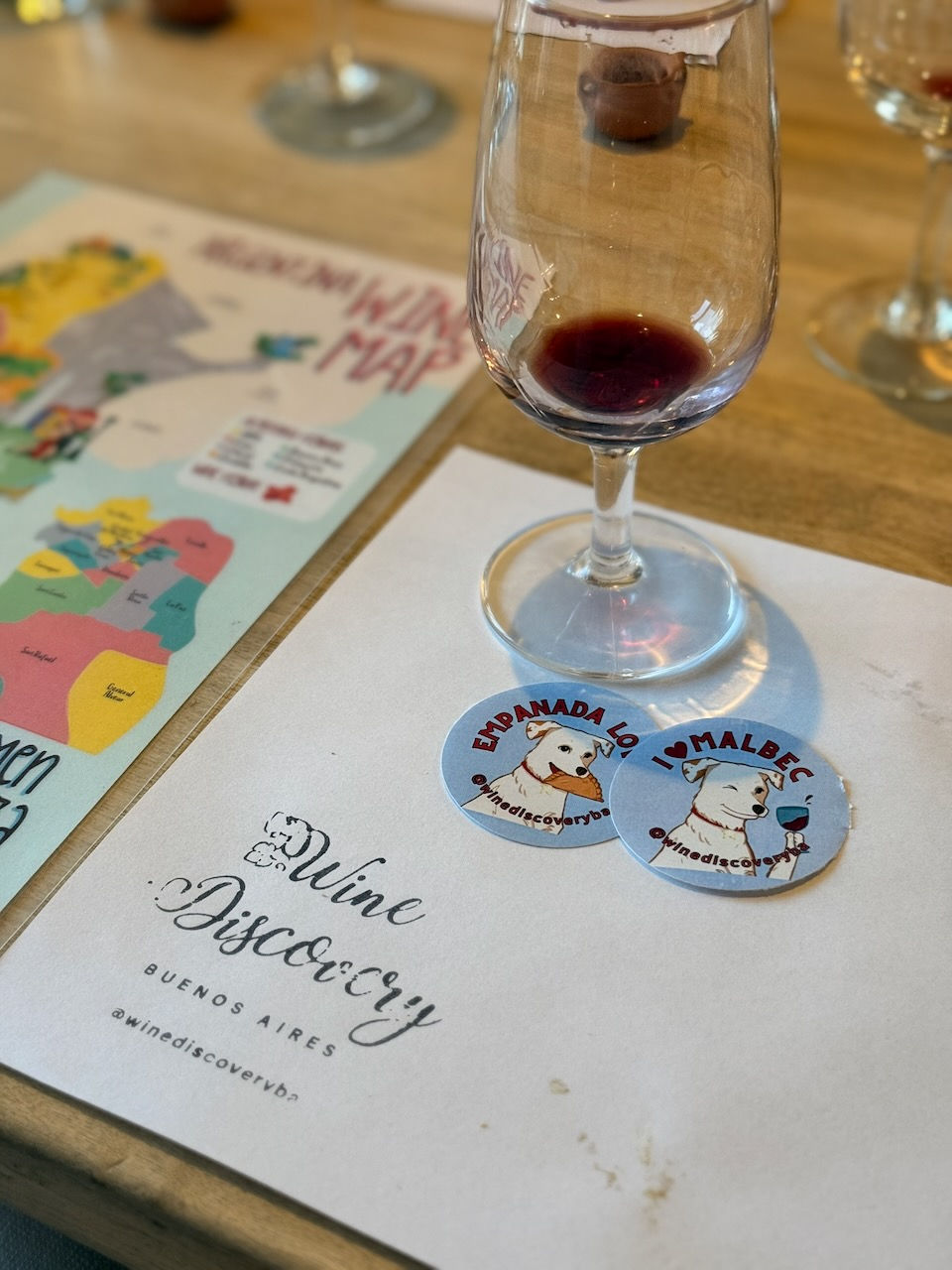
It's a long table with a few good people, a colorful map of Argentina spread out between the glasses, and two hosts who genuinely want you to understand what you're drinking and eating and why.
The tasting runs approximately two hours. Small groups. Private options available. Located at Soler 5650, Palermo Hollywood.
You can book through AsadoAdventure here: wine tasting Buenos Aires
Want to Go Deeper After Your Wine Tasting in Buenos Aires?
The Wine Discovery tasting pairs naturally with a food tour if you want to understand what you're drinking in context. The AsadoAdventure Palermo food and walking tour includes an optional wine tasting add-on — it's a good way to ground the wine in the neighborhoods, history, and food culture that produced it. And if you want to take that further, the at-home asado experience includes both a guided wine tasting at a local wine shop — led by the owner — and wine as part of the asado meal itself. Argentine wine culture and Argentine grill culture in the same afternoon, which is honestly how they were always meant to be experienced.
Argentine food and wine are not separate subjects. They grew up in the same colonial kitchen, fed the same immigrants, survived the same economic crises.
If you leave Buenos Aires thinking Malbec from Mendoza is the whole story, you missed most of it.


Comments